Open-source · Computer vision
SharkTrack
AI software that analyses underwater videos of sharks and rays 21× faster, boosting science and conservation.
Footage shared by Pelagios Kakunja
Overview
What is SharkTrack?
To protect sharks and rays, scientists and conservationists monitor populations using underwater videos, BRUVS, RUVS and ROVs. The bottleneck is manual review: thousands of hours of footage, frame by frame.
SharkTrack is an AI-enhanced video annotation pipeline. It uses computer vision to detect and track sharks and rays in BRUVS videos, and computes the ecology metric (MaxN) ecologists rely on. We tested it in Varini et al. (2024):
21× faster
Computes MaxN semi-automatically, 21 times faster than manual annotation.
89% accuracy
Detects sharks/rays in unseen locations as a single 'elasmobranch' class.
Runs anywhere
Works on a standard laptop, no GPU, no advanced tech requirements.
Used by 17 research and conservation organisations worldwide.
Click a location to explore
How it works
Two steps from raw video to MaxN.
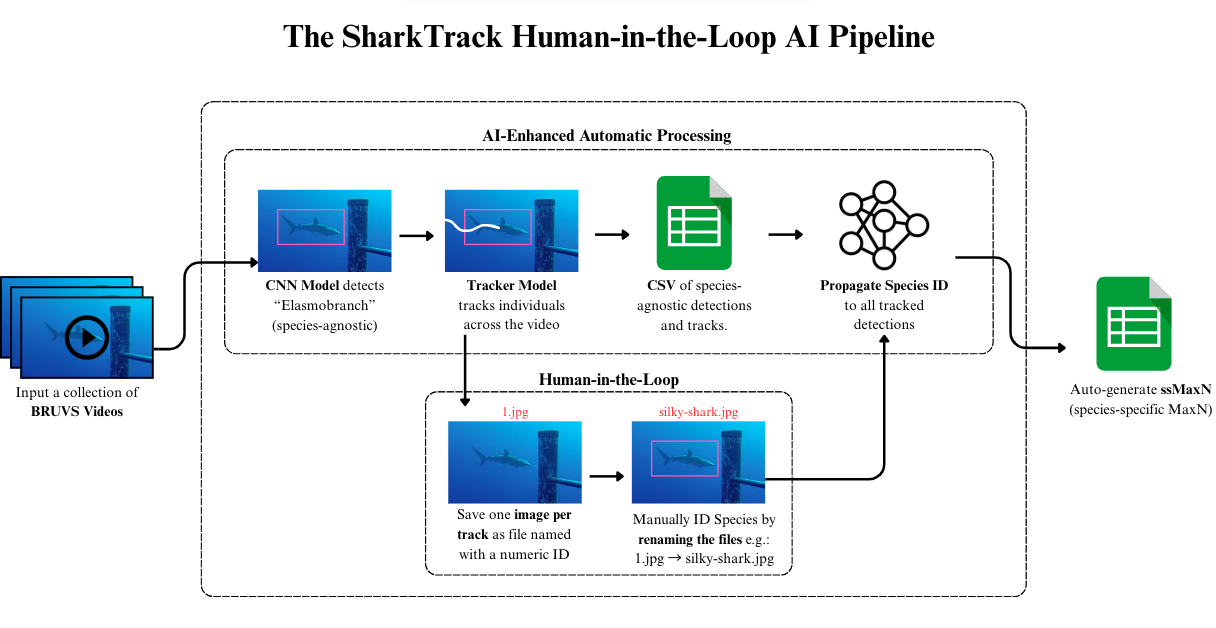
Step 1
Automatic processing
- (a) Ingests every video in a hard drive or folder
- (b) Detects and tracks elasmobranchs frame-by-frame
- (c) Saves sightings into a CSV
- (d) Saves a screenshot for each detected individual
Step 2
Manual review
- (e) Delete false detections (algae, trash)
- (f) Classify species by renaming the screenshot file
- (g) A script propagates the labels and outputs species-specific MaxN
🔎 Analyst mode
Detect and track sharks. Use it to derive relative abundance via MaxN.
👀 Peek mode
Detect only, 5× faster, but no tracking and no MaxN downstream.
Both modes run on a standard laptop and don't require WiFi.
Get started
Free to use, openly developed.
SharkTrack is publicly available. If you don't have experience with Python, don't worry. Following the guide step-by-step, you'll have it running in under 10 minutes.
User Guide
Install SharkTrack and process your BRUVS videos (~10 min)
📊Annotation Pipeline
Review detections and compute species-specific MaxN
Questions? Contact us.
Publication
Cite our work.
Varini, F. et al. (2024). SharkTrack. GitHub. github.com/filippovarini/sharktrack
@article{varini2024sharktrack,
  title={SharkTrack: an accurate, generalisable software for streamlining shark and ray underwater video analysis},
  author={Varini, F. and Gayford, J. H. and Jenrette, J. and Witt, M. J. and Garzon, F. and Ferretti, F. and Glocker, B.},
  journal={arXiv preprint arXiv:2407.20623},
  year={2024}
}
Licensed under MIT. Submit issues on GitHub , we usually respond within a week.
Contributors
Built by many hands.
SharkTrack and the related work were supported by the efforts of Filippo Varini, Joel H. Gayford, Jeremy Jenrette, Matthew J. Witt, Francesco Garzon, Francesco Ferretti, Sophie Wilday, Mark E. Bond, Michael R. Heithaus, Danielle Robinson, Devon Carter, Najee Gumbs, Vincent Webster, Ben Glocker, Fabio De Sousa Ribeiro, Rajat Rasal, Orlando Timmerman, Natalie Ng, Rui Wen Lim, Michael Sellgren, Lara Tse, Steven Chen, Maria Pia Donrelas, Manfredi Minervini, Xuen Bei (Bay) Chin, Adam Whiting, Aurora Crocini, Gabriele Bai and Stephanie Guerinfor.
Want to contribute?
Pull requests, issues and ideas are welcome over email. SharkTrack is a first step toward generalisable marine-species classifiers, we're looking for collaborators on AI-driven ocean conservation. If that's you, get in touch.